

Ask how many types of negotiation there are and you will get different answers. Many guides list two; others list five or nine, mixing approaches such as “win-win” with formats such as team or multiparty negotiation. For commercial negotiators, the more useful question is practical: how will value be divided or created in this negotiation, and what does that demand from you?
On the IMPACT Negotiation Gauge, there are four types of negotiation, running from transactional to collaborative: Auction, Value Distribution, Value Enhancement and Value Creation. Auction and Value Distribution are distributive: the parties compete over a fixed amount of value. Value Enhancement and Value Creation are integrative: the parties trade or create value so that both sides can end up better off.
Negotiation research has long distinguished two broad types. Richard Walton and Robert McKersie described distributive and integrative bargaining in A Behavioral Theory of Labor Negotiations (1965), and Roger Fisher and William Ury’s Getting to Yes (1981) popularised the idea of negotiating on interests rather than positions.
That split is still the foundation. In B2B practice, however, two categories hide important differences. A competitive tender is not the same as a one-to-one price negotiation, and trading payment terms for volume is not the same as jointly redesigning a supply chain. The IMPACT Negotiation Gauge separates these situations into four types, each with its own conditions and behaviours.
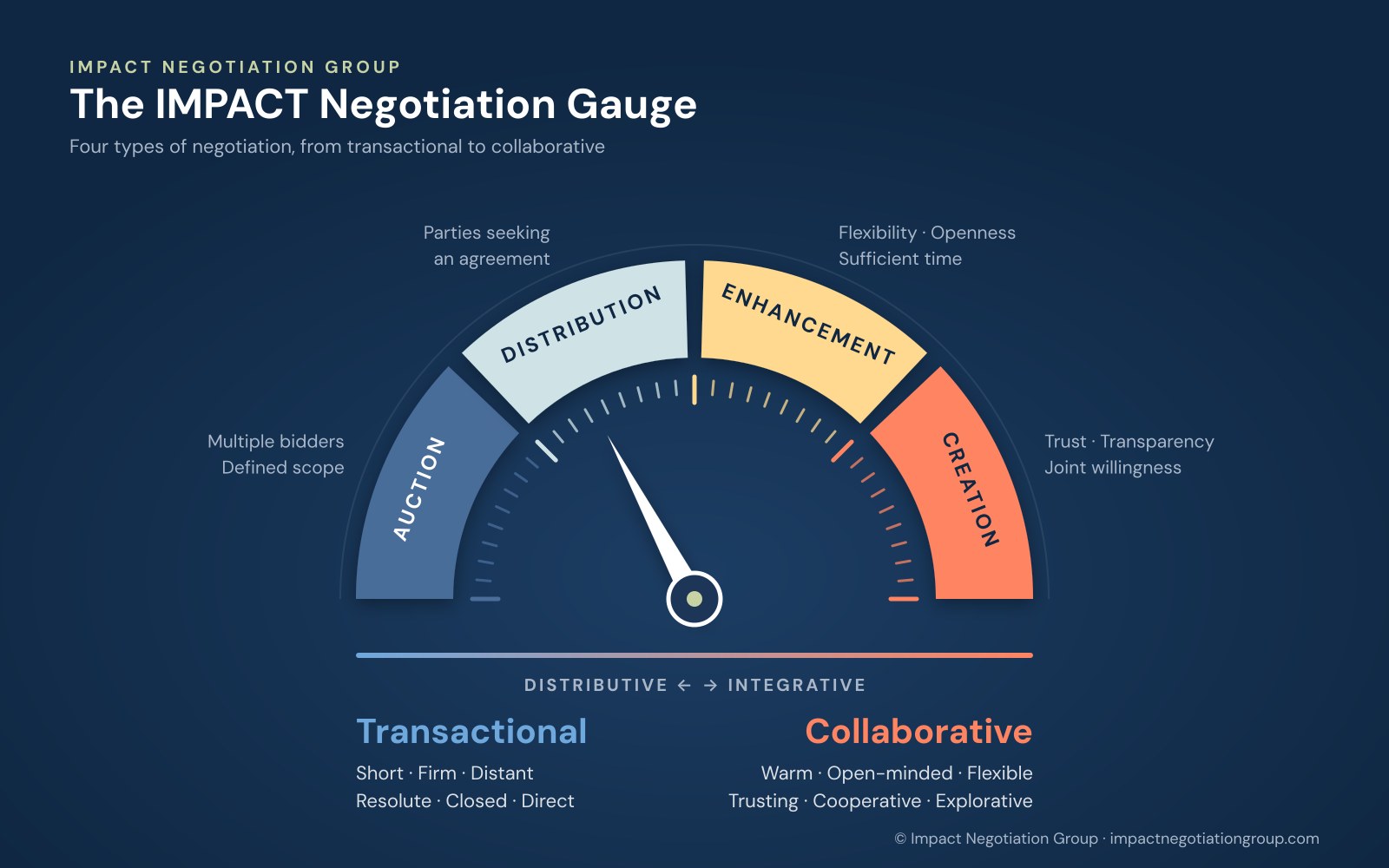
| Type | How value is handled | Conditions needed | Approach |
|---|---|---|---|
| 1. Auction | Several parties compete under set rules for the right to buy or sell | Multiple buyers or sellers, a defined scope, standardised assessment | Distributive |
| 2. Value Distribution | A fixed amount of value is divided; one side’s gain is the other’s loss | Parties seeking an agreement | Distributive |
| 3. Value Enhancement | Concessions are traded so the deal grows for both sides | Flexibility, openness, sufficient time | Integrative |
| 4. Value Creation | Both parties jointly create far more value than either could alone | Creativity, openness, transparency, joint time and willingness, a focus on interests | Integrative |
An auctioning party invites several parties to submit offers according to specific rules and a defined scope. The bidders compete with each other for the right to buy from or sell to the auctioning party. Tenders, requests for quotation and e-auctions are common B2B examples. See our tips for maximising your tender potential.
Two parties want an agreement, but they compete to divide a fixed amount of value. The negotiation is zero-sum: one party’s gain is the other party’s loss. This is what most people mean by distributive negotiation.
The parties work together to optimise the outcome by trading concessions. Variables that cost one side little are exchanged for variables the other values highly, increasing the overall value of the deal for both. This is the first form of integrative negotiation.
Both parties together create significantly more value than either would have achieved alone. They identify and share their interests and priorities and jointly develop creative solutions that benefit both. It is the most collaborative type, and the one with the most demanding preconditions.
For how to use the framework when you prepare, read our guide to the IMPACT Negotiation Gauge.
Distributive negotiation focuses on dividing a fixed pie: the parties compete over how much each receives, often through a single variable such as price. The zone of possible agreement (ZOPA) exists where the parties’ acceptable outcomes overlap.
Integrative negotiation seeks to expand the pie by introducing additional variables, such as timing, payment terms, scope, or risk allocation. When parties value these variables differently, they can make trade-offs that address each side’s priorities—conceding on something less important to gain something more valuable.
These trade-offs can expand the ZOPA, or create one where none initially existed, increasing the likelihood of an agreement. The key is not simply adding more variables, but finding differences in priorities that create opportunities for mutual gain.
Many negotiation schools present distributive negotiation as inferior to an integrative approach. Yet distributive bargaining is common in B2B negotiations—and it can be entirely appropriate.
The choice is not about which approach is inherently better. It is about what fits the situation. Integrative negotiation typically requires more time, deeper preparation, sufficient mutual trust, and a willingness to understand each other’s priorities. When those conditions are in place, a collaborative approach can create greater value for both parties.
On the IMPACT Negotiation Gauge, these conditions are what separate the transactional side (Auction and Value Distribution) from the collaborative side (Value Enhancement and Value Creation).
But those conditions are not always present. Effective negotiators need to know how to create value through integrative negotiation and claim value through distributive bargaining—often within the same negotiation.
| Distributive negotiation | Integrative negotiation | |
|---|---|---|
| Types on the gauge | Auction, Value Distribution | Value Enhancement, Value Creation |
| View of value | Fixed: one side’s gain is the other’s loss | Can be increased by trading or joint problem-solving |
| Variables | Often one, such as price | Several, such as timing, payment terms, scope and risk |
| Information sharing | Limited and guarded | Priorities and interests are explored and shared |
| Behaviour | Short, firm, distant, resolute, closed, direct | Warm, open-minded, flexible, trusting, cooperative, explorative |
| What it requires | Parties seeking an agreement | Time, preparation, trust and willingness on both sides |
Each type calls for different behaviour. In a transactional negotiation, being short, firm and direct protects your position. In a collaborative negotiation, the same behaviour can shut down the exchange of information that value creation depends on. Decide your position before you meet, and make sure your opening, your proposals and your reactions are consistent with it.
Use these questions to decide where to position a negotiation:
Remember that you can influence where a negotiation sits, but you cannot decide it alone. Prepare for the position you want and for the one the other party may choose.
Many lists of negotiation types also include team negotiation, multiparty negotiation, online negotiation or principled negotiation. These describe who negotiates, through which channel or with which method. They can apply to any of the four types above: a team can run an auction, and a multiparty negotiation can create value. The gauge focuses on the question that shapes your strategy most: how value is divided or created.
On the IMPACT Negotiation Gauge, the four types are Auction, Value Distribution, Value Enhancement and Value Creation. The first two are distributive and transactional; the last two are integrative and collaborative.
Distributive negotiation divides a fixed amount of value, often over a single variable such as price. Integrative negotiation increases the value available by introducing variables the parties value differently and trading them.
Yes, and most B2B negotiations are. Parties often create value by trading variables and then compete over how that value is divided. Even when both sides are better off, the value created is rarely split equally.
Our training programs teach negotiators to do both, and to recognise when each approach is most effective.
Explore our training programs to learn more.

Our Negotiation Consulting services leverage a proven, successful methodology to deliver exceptional outcomes. We empower our clients either through direct support (consulting) or long-lasting capability development to achieve the best possible results in every negotiation.