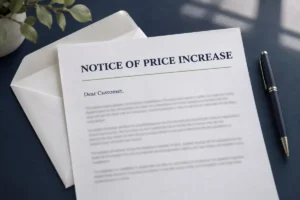
In short: Negotiation techniques are the tools you use to steer a negotiation instead of reacting to it. The five most effective in business are preconditioning before the meeting, a deliberately high opening, framing, firm proposals instead of soft language, and recognising the other side’s hard tactics. What matters is not the technique. What matters is the moment.
We have trained 6,746 negotiators and supported deals worth €6.3 billion. The techniques below are the ones we see working in real price rounds, annual negotiations and tenders. Not the ones that look good on a slide.
| Technique | When to use it | When it backfires | Read more |
|---|---|---|---|
| Preconditioning | Weeks before the meeting | When the message is clumsy or comes too late | Preconditioning |
| Extreme opening | With the first offer, when you know the market | When you cannot justify the anchor | The power of the extreme opening |
| Framing and reframing | Whenever you present price or value | When the frame is obviously manipulative | Framing and reframing |
| Firm proposals | With every offer and every concession | Never. Soft language always costs | Weak language & firm proposals |
| Countering hard tactics | As soon as the other side applies pressure | When you hit back instead of naming it | Distributive negotiation tactics |
Most negotiations are not decided at the table but before it. Preconditioning means shaping the other side’s expectations before the first offer is made: through the right people, the right channels and a clear message. If you only raise the price increase in the meeting, you are negotiating from the defensive. How to identify key people and choose your timing is covered in our article Preconditioning: the strategic art of influencing negotiations.
The first offer is the strongest move you have. It sets the reference point against which everything else is measured. A deliberately ambitious opening works when you know the market better than the other side and can justify the anchor. Without a justification it is just a loud number. When it works and how to respond to an extreme opening from the other side is explained in The power of the extreme opening.
The same number can sound expensive or cheap. Framing means presenting facts so that the other side interprets them your way: a 2% price increase against an 8% rise in costs sounds different from simply 2% more. Reframing is the counter-move when the other side has set the frame. Both in detail: The power of framing and reframing in negotiations.
“We could possibly imagine” is not an offer. It is an invitation to renegotiate. Experienced buyers hear soft language immediately and push exactly there. A firm proposal states the number, the condition and what you want in return, without softeners. Which phrases to cut is shown in Weak language & firm proposals.
Salami tactics, good cop and bad cop, the artificial deadline, the “nibble” just before signing: distributive tactics are not unfair, they are tools. They only become dangerous when you do not recognise them. The most effective defence is almost always to name the tactic calmly. All seven tactics with countermeasures: Distributive negotiation tactics: what are they and why we use them.
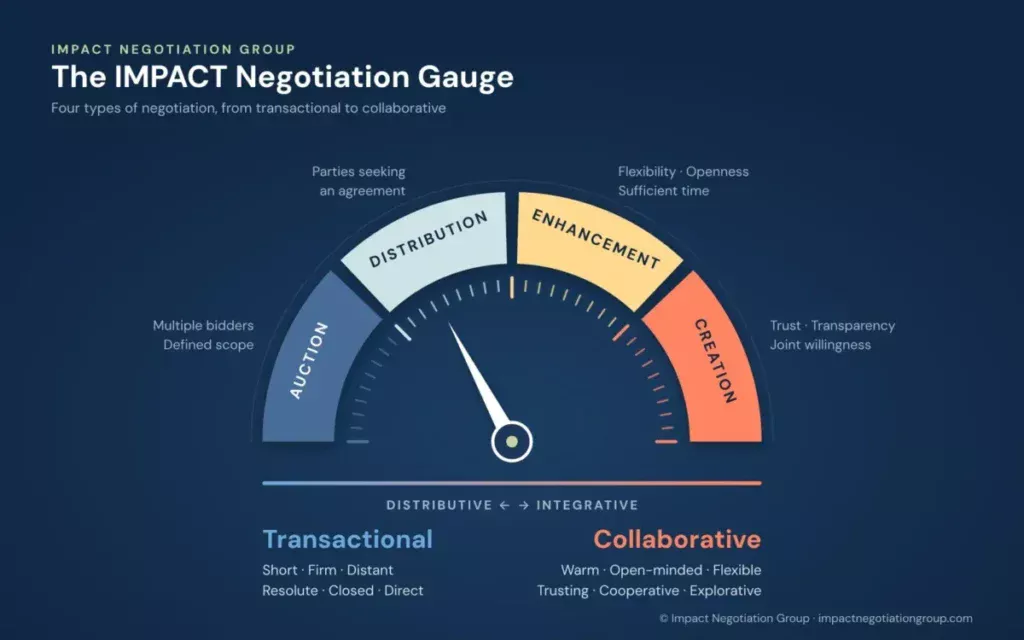
A negotiation strategy is the decision about what kind of negotiation you are conducting, made before you choose a technique. Our IMPACT Negotiation Gauge distinguishes four types, from purely transactional to collaborative. In a transactional price round, anchors and firm proposals count. In a long-term partnership, framing and preconditioning count for more than the last euro. Most mistakes are not caused by the wrong technique, but by the right technique in the wrong kind of negotiation. The terms behind it are explained in our glossary Negotiation terms and definitions.
In the negotiations we support, we keep seeing the same patterns that cost money:
None of these gaps is closed with a new technique alone. You close them with preparation and practice. When we trained 153 procurement professionals from 4 companies in 2025, they saved €143,758 per person on average, measured with the clients’ own cost-saving trackers. That is an ROI of 22.3x.
What are the most important negotiation techniques?
Preconditioning, a well-founded high opening, framing, firm proposals and recognising hard tactics. Which of these delivers the most depends on the type of negotiation.
What is the difference between a negotiation technique and a negotiation strategy?
The strategy determines what kind of negotiation you are conducting and what you want to achieve. The technique is the tool you use to put that strategy into practice at the table.
Does the Harvard method work in business?
In collaborative negotiations, yes. In hard price rounds with trained buyers it is not enough on its own: there you also need distributive techniques and the ability to recognise them in the other side.
Can negotiation techniques be learned?
Yes, but not by reading alone. Techniques only stick once you have practised them under pressure, ideally in realistic simulations with video feedback.
Reading about techniques is the easy part. Applying them under pressure, when the buyer goes silent and the deadline is running, is the hard part. That is exactly what we train: in small groups, always with a partner, with video feedback. More in our negotiation training, specifically for your team in our negotiation training for sales or our procurement negotiation training.

Our Negotiation Consulting services leverage a proven, successful methodology to deliver exceptional outcomes. We empower our clients either through direct support (consulting) or long-lasting capability development to achieve the best possible results in every negotiation.