Quick answer: BATNA stands for Best Alternative To a Negotiated Agreement: what you will do if this negotiation fails. It sets your walk-away point. The stronger your BATNA, the less you need the deal and the more you can ask for. The term comes from Fisher and Ury’s book Getting to Yes (1981).
We have trained 6,746 negotiators and supported €6.3 billion in deals. In almost every one of those negotiations, the side that had worked out its BATNA before the first meeting set the terms.
| Term | What it means | Example in a supplier negotiation |
|---|---|---|
| BATNA | Your best option if there is no deal | Switch to the second-best supplier |
| Walk-away point | The worst deal you will still accept, derived from your BATNA | €104 per unit, including switching costs |
| ZOPA | The range where both sides’ walk-away points overlap | Between €98 and €104 per unit |
| WATNA | Your worst realistic outcome if there is no deal | No supplier in time, production stops |
Your BATNA is not what you want. It is what you will do if you walk out. For a buyer that might be the second-best supplier, a longer contract with the current one, or making the product in-house. For a seller it might be another customer for the same volume, or simply keeping the capacity free. The point of knowing it: you never accept a deal that is worse than your alternative, and you never walk away from one that is better.
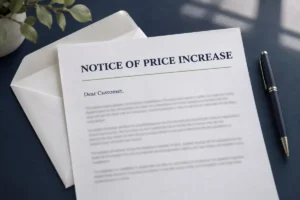
A supplier announces a 9% price increase. The buyer’s options: accept, or move the volume to another supplier who quotes €100 per unit plus €4 per unit in switching costs for the first year. That alternative, at €104, is the buyer’s BATNA. Any deal with the current supplier above €104 is worse than walking away. Anything below is worth negotiating for. Without that number, the buyer is negotiating against a feeling, not a fact.
A BATNA is not fixed. It is built, and it is built early. Ask a second supplier for a real quote months before the renewal. Free up internal capacity. Align your stakeholders so nobody undermines the alternative. Shaping the other side’s expectations before the meeting is the same discipline we describe in our article on preconditioning. The weakest position at any table is the one with no alternative and no time to build one.
Your leverage depends on their alternatives as much as yours. Ask what they will do if you walk: do they have spare capacity, other customers, a deadline? A supplier with idle production lines has a weak BATNA, whatever the price list says. Getting inside the head of the other party is the most underused part of preparation.
Your BATNA sets your walk-away point, theirs sets their walk-away point, and the overlap between the two is the ZOPA, the zone of possible agreement. If the walk-away points do not overlap, there is no deal to be had, however good the negotiators. We explain this step by step, with worked examples, in ZOPA in Negotiation.
Only if it is strong and credible, and even then carefully. A strong alternative mentioned at the right moment moves the other side. A weak one revealed too early tells them exactly how far they can push. Most of the time, let your behaviour show you have options; keep the number to yourself.
What does BATNA stand for?
Best Alternative To a Negotiated Agreement: the best thing you can do if this negotiation produces no deal.
Is BATNA the same as your walk-away point?
No. The BATNA is the alternative itself; the walk-away point is the worst deal you will accept, derived from it.
What is WATNA?
Worst Alternative To a Negotiated Agreement: the worst realistic outcome if there is no deal. It shows how much is at risk if you walk away.
Can you negotiate without a BATNA?
You can, but you negotiate blind. Without an alternative you cannot tell a good offer from a bad one, and the other side will sense it.
Knowing your BATNA takes ten minutes of thinking. Building a strong one, and using it under pressure without giving it away, takes practice. That is what we train, with your real negotiations as the cases: in our negotiation training, and for buying teams in our procurement negotiation training. More techniques in one overview: Negotiation techniques: what really works at the negotiating table.

Our Negotiation Consulting services leverage a proven, successful methodology to deliver exceptional outcomes. We empower our clients either through direct support (consulting) or long-lasting capability development to achieve the best possible results in every negotiation.