
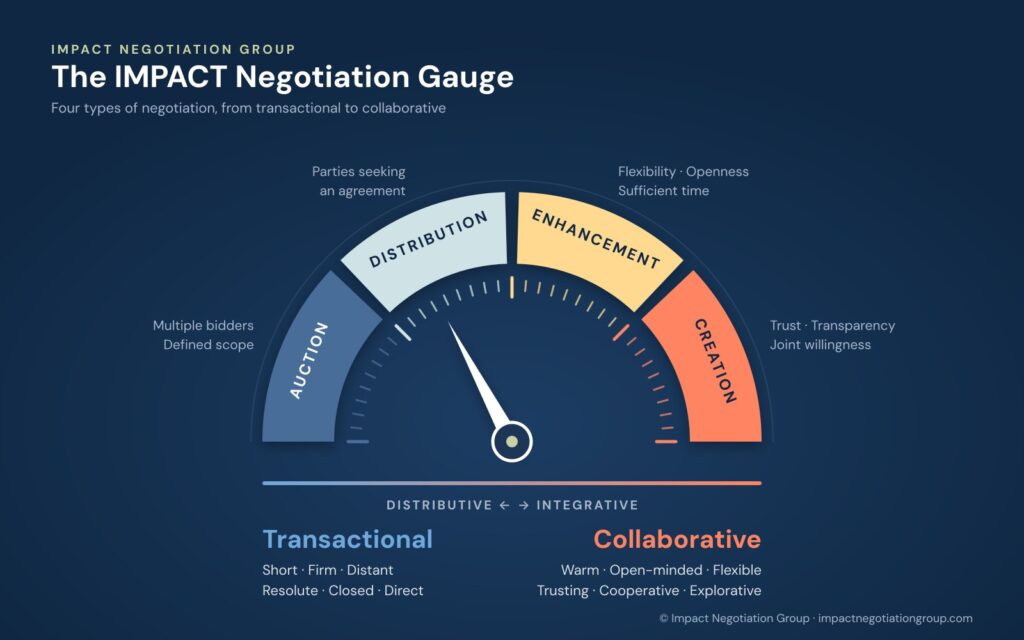
The IMPACT Negotiation Gauge identifies four negotiation archetypes: Auction, Value Distribution, Value Enhancement, and Value Creation. It helps negotiators make a conscious choice about how to approach a negotiation—and recognise the conditions needed to make that approach work.
The gauge runs from transactional on the left to collaborative on the right. The transactional side is where distributive negotiation takes place: the parties compete over a fixed amount of value. The collaborative side is where integrative negotiation takes place: the parties increase the value available before they divide it. For a broader overview, see our guide to the types of negotiation.
| Archetype | What happens | Conditions needed | Side of the gauge |
|---|---|---|---|
| Auction | One party sets the rules and scope; several parties compete for the right to buy from or sell to it. | Multiple buyers or sellers, a defined scope, standardised assessment | Transactional |
| Value Distribution | The parties divide a fixed amount of value: one side’s gain is the other’s loss. | Parties seeking an agreement | Transactional |
| Value Enhancement | The parties trade concessions, exchanging low-cost variables for high-value ones, so the deal grows for both. | Flexibility, openness, sufficient time | Collaborative |
| Value Creation | The parties share interests and priorities and jointly develop solutions worth far more than either could reach alone. | Creativity, flexibility, openness, transparency, sufficient joint time, joint willingness, a focus on interests | Collaborative |
In an auction, one party sets the rules and the scope, and several parties compete to win the business. Tenders, requests for quotation and e-auctions are typical B2B examples. The auctioning party uses competition to improve the offer; each bidder decides how far it is prepared to go to win. Our article on maximising your tender potential looks at this from the bidder’s side.
In value distribution, two parties want to reach an agreement, but the value on the table is treated as fixed. Whatever one side gains, the other gives up, and price is often the only variable that really counts. This is classic distributive negotiation.
In value enhancement, the parties bring more variables into the deal and trade them. Each side gives way on variables that cost it little and gains on variables it values more, so the total value of the deal grows for both. This is the first step into integrative negotiation.
In value creation, the parties go further. They share their interests and priorities openly and develop solutions together that neither could have reached alone. This is the most collaborative position on the gauge and the most demanding one: it needs time, transparency and genuine willingness on both sides.
Each side of the gauge calls for different behaviour. On the transactional side, effective negotiators are short, firm, distant, resolute, closed and direct. On the collaborative side, they are warm, open-minded, flexible, trusting, cooperative and explorative. Neither set of behaviours is better in itself. What matters is that your behaviour matches the position you have chosen.
The same applies to how you react to the other party’s proposals. A firm, visible rejection is credible in a transactional negotiation; the same reaction can damage trust in a collaborative one.
Without deliberate preparation, negotiations can easily default to the transactional side of the gauge, where the primary focus is price and claiming value. Moving towards the integrative, value-creating side requires more preparation, an understanding of each party’s priorities, and sufficient trust and willingness to collaborate. When these conditions are in place, the potential for mutual gain is greater.
Transactional negotiation remains common in B2B business, and it can be entirely appropriate. Effective negotiators need the skills to operate across the gauge, choosing their approach according to the situation, their objectives, and the other party’s behaviour.
Before entering a negotiation, decide where you want to position it and assess whether the necessary conditions are in place. You can influence that position, but you cannot determine it alone.
Work through these questions as part of your preparation:
If the other party takes a transactional approach, first explore whether you can establish a more collaborative conversation. If they remain focused on claiming value, adapt accordingly: protect your interests, make concessions conditional, and seek something in return. Collaboration creates opportunities, but it must be matched by the ability to negotiate firmly.
Your position on the gauge also changes how you work with the zone of possible agreement (ZOPA): the range between both parties’ walk-away points. On the transactional side you usually negotiate within a single ZOPA, often on price. Towards the collaborative side, each variable has its own ZOPA, and trading across variables can create agreement where none seemed possible. Our guide to ZOPA in negotiation explains how.
The IMPACT Negotiation Gauge is Impact Negotiation Group’s framework for choosing how to approach a negotiation. It places four negotiation archetypes (Auction, Value Distribution, Value Enhancement and Value Creation) on a scale from transactional to collaborative, together with the conditions and behaviours each one requires.
No. A collaborative approach can create more value for both parties, but only when the conditions are in place: time, preparation, trust and willingness on both sides. When they are not, a well-executed transactional negotiation is often the right choice.
You can influence it, but you cannot determine it alone. Introducing new variables, asking about the other party’s priorities and building trust can move a negotiation towards the collaborative side. If the other party keeps focusing on claiming value, adapt your approach and protect your interests.
The IMPACT Negotiation Gauge is at the core of our negotiation training. Our programmes help negotiators choose where to position a negotiation, read the other party and adapt their behaviour, from firm, transactional bargaining to collaborative value creation.

Our Negotiation Consulting services leverage a proven, successful methodology to deliver exceptional outcomes. We empower our clients either through direct support (consulting) or long-lasting capability development to achieve the best possible results in every negotiation.