
Many teams still negotiate as if costs stay calm and pricing moves on a steady clock. That model worked in 2015. It fails in 2026.
Input costs now move in weeks. Retail pricing often moves in quarters. Retailers guard shelf prices and push back hard on increases. Shoppers switch to cheaper brands fast. Private label wins the basket with little friction.
So the old deal logic breaks. You ask for a price increase. The retailer asks for a concession. You trade moves until someone blinks. The agreement looks finished, but the market shifts again. Then the deal reopens.
This gap creates real damage. Costs jump quickly, but pricing processes stay slow. The negotiation becomes a race against timing, not a discussion about value.
That delay forces more short-term compromises. It also makes contracts weaker the moment the market shifts.
Negotiations now stretch across more weeks and more stakeholders. Teams spend hours in calls, email chains, and approval loops.
Deals also lose durability. Terms that look acceptable in the moment often fail once costs shift again. Trust weakens, effort increases, and both sides end up repeating the same arguments with less patience each time.
Volatility hits, and one side claims the other side “knew” what was coming. The tone shifts from trade to blame.
Margins disappear in small cuts. A 0.5 percent concession here. A funded promotion there. A delayed increase for 60 days. Add that across categories and accounts, and the year disappears.
Retailer groups keep getting bigger. Private label quality keeps rising. Brand loyalty keeps weakening. That power shift shows up in every line review and every price discussion.
Pricing talks no longer sit in one room. They spread across portals, video calls, and long email threads.
Each channel strips context. People misread intent. Screenshots replace conversation. Trust becomes harder to hold.
Gen Z now fills many roles in sales ops, category, and procurement support. They expect clear reasons, fast replies, and direct language.
Old status games slow talks down. Vague claims trigger pushback. Authority needs explanation, not assumption.
Price is one tool. It is not the whole deal.
Strong deals now include risk-sharing terms, clear review triggers, and market-based adjustment rules. A 5 percent cost move for two months should activate a defined reset.
Transparency matters. Share cost drivers that can be checked. Agree on timelines that work in real markets, not old cycles.
Volatility will stay. The bigger danger is a negotiation model that turns every cost move into conflict.
Companies that rebuild how they negotiate will protect margins and partnerships. Companies that cling to old habits will face constant breakdowns.
If your commercial negotiations are starting to feel slower, harder, and less stable, it is time to redesign the way you negotiate. Contact us to discuss how risk-sharing deal structures and clearer negotiation processes can protect margins and strengthen retailer relationships in volatile markets.
Strong negotiation results rarely come from talent alone.
They come from preparation, judgment, and disciplined thinking.
The books below have shaped how experienced negotiators prepare deals, run conversations, and decide under pressure. They focus on what drives outcomes before, during, and after the meeting.
This list is written for negotiators, consultants, and commercial leaders who want repeatable results, not tricks.
Negotiation begins with how the other side sees the situation.
Stuart Diamond built this book from decades of teaching at Wharton and thousands of real cases. His work shows that people act on perceptions of fairness, respect, and gain. Logic alone rarely moves behavior.
The book trains you to identify interests, not positions. It pushes negotiators to search for low-cost trades, small concessions, and non-monetary value. These moves create momentum and trust, which often lead to larger agreements.
This is one of the most practical books for preparation and role-based exercises. Many teams use its structure as a foundation for negotiation training.

This book explains why people agree.
Robert Cialdini documents six principles that guide decision-making. Reciprocity, commitment, social proof, authority, liking, and scarcity shape behavior in predictable ways. These patterns appear in sales talks, procurement reviews, and internal negotiations.
The value of this book sits in awareness. Once you understand these drivers, you see influence at work long before price or terms appear. Timing, framing, and sequence matter more than strong arguments.
For commercial professionals, this book sharpens meeting design and proposal structure.

High-stakes conversations decide most deals.
This book focuses on moments where opinions differ and consequences matter. Under pressure, people tend to withdraw or attack. Both reactions damage outcomes.
The authors provide tools to keep dialogue productive. You learn how to speak clearly without triggering defensiveness and how to manage emotion without avoiding the issue. The focus stays on facts, shared purpose, and mutual respect.
Every major negotiation contains at least one crucial conversation. This book prepares you to handle it well.
Price discussions fail when value stays vague.
Alan Weiss reframes commercial conversations around outcomes, not effort. He draws a clear line between cost and value and shows how to anchor discussions on results that matter to the client.
The book provides clear language for scope, fees, and boundaries. It helps professionals avoid endless revisions and unpaid work.
Although written for consultants, the principles apply to any role where expertise is sold. It is a strong guide for commercial confidence.

Most negotiators focus only on the meeting.
This book expands the field of view. Lax and Sebenius show that outcomes depend heavily on set-up and deal structure. Who is involved, what issues are linked, and when talks occur often matter more than table tactics.
The authors introduce tools to reshape the negotiation environment before discussions begin. This includes sequencing, coalition building, and option design.
For complex deals, renewals, and multi-party negotiations, this book changes how leverage is created.
Negotiators trust their judgment too quickly.
Daniel Kahneman explains two modes of thinking. One is fast and intuitive. The other is slow and deliberate. Most negotiation errors come from relying on the first when the second is needed.
The book details common bias patterns such as anchoring, confirmation bias, and overconfidence. These distort listening, evaluation, and choice.
Reading this book builds discipline. It helps negotiators slow down, test assumptions, and make cleaner decisions.
Listening fails under pressure.
Kate Murphy explores why attention drops when stakes rise. Distraction, status, and the urge to reply block real understanding. The book draws lessons from journalists, intelligence professionals, and researchers.
The core message is simple. Curiosity improves influence. Asking clear questions and staying silent long enough produces better information and stronger relationships.
This book fits well with preparation work and stakeholder management.

Strong negotiators ask better questions.
Michael Bungay Stanier presents seven short questions that improve conversations. The focus stays on inquiry, not advice. These questions surface interests, constraints, and priorities.
The book helps negotiators avoid solving the wrong problem. It builds trust without giving up control and keeps discussions focused on action.
Negotiation often starts with questions, not arguments. This book reinforces that discipline.
Reading alone does not improve negotiation.
Testing ideas does.
Each book on this list strengthens a different part of the process. Preparation, influence, judgment, listening, and deal structure all shape results.
Use these books as working tools, not theory.
Most negotiators prepare facts, pricing, and terms.
Many still leave value on the table.
The reason is simple. Bias changes what you notice, what you trust, and what you decide.
Bias does not feel irrational.
It feels like “good judgment.”
That is why it is expensive.
This article covers nine traps that show up in day-to-day negotiations.
Each section includes a plain definition, a real deal example, and a practical fix.
Anchoring happens when the first number sets the reference point.
People adjust away from it too little.
Example
A supplier opens a renewal with a 12% increase.
The buyer planned for 3%.
After two meetings, they “win” 6%.
That outcome still tracks the first number, not the market.
What to do
Walk in with your own anchor and your reasons.
Use benchmarks like last year’s price, competitor quotes, or input costs.
Name the anchor out loud when it is extreme.
Say, “That number is not a useful starting point. Here is ours.”
Confirmation bias makes you search for support and ignore friction.
You hear what fits your story.
Example
A sales team believes the client has budget.
One friendly manager said, “We should be fine this quarter.”
The team ignores two warnings from procurement about approvals.
The deal slips by 90 days, then the scope gets cut.
What to do
Run one “disproof” check before you commit.
Ask, “What fact would kill this deal?”
Then chase that fact on purpose.
Invite one colleague to argue the other side for ten minutes.
Framing changes choices through wording.
The facts stay the same.
Example
You propose a clause change.
You say, “This prevents a 5% revenue loss.”
The other side reacts fast and agrees to discuss it.
If you say, “This raises revenue by 5%,” they show less urgency.
What to do
Test two frames before you present a key ask.
Use a gain frame and a loss frame.
Then strip the words back to the numbers and the risk.
Decide based on substance, not emotion.
This bias makes you judge others as “difficult” or “unreasonable.”
You ignore the situation shaping their behavior.
You also assume they see the deal like you do.
Example
A buyer asks for a discount on June 28.
The supplier refuses and sounds cold.
The buyer labels them stubborn.
The real issue is authority. The supplier’s rep cannot approve changes after month-end close.
What to do
Ask one clean question before you judge intent.
“What pressures or rules sit behind that position?”
Then listen for internal limits, incentives, and approval paths.
You can solve real constraints. You cannot solve a label.
Overconfidence makes you overrate your read of the room.
It also cuts preparation time.
Example
A senior leader joins the final call and expects a quick close.
They skip the prep brief.
The counterpart adds legal and finance to the call.
New terms appear, and the timeline doubles.
What to do
Write down three things you do not know.
Turn each into a question for the other side.
Build two deal paths, one fast and one slow.
Treat certainty as a result of preparation, not a mood.
People feel losses more strongly than gains of the same size.
A small concession can feel huge.
Example
A client asks to remove a minor penalty clause.
Your team refuses.
The clause has low value to you, but giving it up feels like losing.
The refusal blocks a larger win, a two-year extension worth €400,000.
What to do
Translate “losses” into trades.
Say, “If we remove that clause, we need X in return.”
Keep a simple trade list on paper: price, term, volume, payment, scope, service levels.
Move value across items instead of fighting on one point.
Sunk costs trap you in a bad path.
Time spent feels like a reason to keep going.
Example
A team spends five months on a partnership deal.
New numbers show the margin will drop from 18% to 6%.
Leadership pushes to sign anyway.
They say, “We cannot waste five months.”
What to do
Set exit rules before talks start.
Write a floor on margin, risk, and cash terms.
Review those floors after each major change.
Past time is gone. Your signature decides future pain.
A halo forms when you like or admire the other person.
A horn forms when you dislike them.
Both distort how you judge their proposals.
Example
A charismatic vendor rep presents a complex pricing model.
The buyer accepts it with light scrutiny.
A less liked rep presents a simpler model later.
The buyer rejects it on instinct, then misses savings.
What to do
Separate the person from the term sheet.
Score proposals against a short checklist: total cost, risk, timeline, exit terms.
Have a second reviewer check any deal that “feels right” fast.
Fast comfort often signals bias.
Fixed-pie bias treats negotiation as zero-sum.
You fight over one number and ignore other levers.
Example
Two parties argue for weeks over a 4% price gap.
They never discuss payment timing or contract length.
A 12-month prepay would solve cash needs for one side.
A longer term would justify the discount for the other.
What to do
Add at least three issues to the agenda.
Use the same list every time: price, volume, timing, scope, service, term.
Ask what matters most and least to each side.
Trade low-cost items for high-value items.
Bias does not show up as “bias.”
It shows up as a reasonable story you tell yourself.
That story shapes your numbers, your tone, and your choices.
Pick one bias from this list before your next negotiation.
Name it on your prep sheet.
Decide what you will do when it appears.
Perception has a sneaky habit of dressing up as fact during negotiations. One side frames shipping costs as prudent stewardship; the other hears margin erosion. We label a delivery window as “flexible,” and they translate it to “production chaos.” Each party leaves the room convinced the other simply doesn’t get it.
This blindness, treating a personal snapshot as the whole picture, drains trust, erodes value, and can stall a deal before the espresso cools. Spotting the gap is step one; purposefully stepping into the other side’s perspective turns friction into collaborative gain.
Perception is your instant read on a deal, such as price targets, timelines, gut-level fears, that are shaped by memories, biases, and emotion.
Perspective asks you to step outside that frame and view the world through the other party’s eyes: their KPIs, political pressures, and personal reputations.
Everyone defaults to personal perception (we’re the stars of our own story). Treating that viewpoint as the only reality is a costly error. Two negotiators rarely look at the same spreadsheet and see the same bottom line; priorities and pressures diverge. Miss that divergence and you’ll misread motives, overlook openings, and slip into deadlock.
Negotiators anchored to a single viewpoint often talk past each other. They champion their wish list while sidestepping what matters across the table. Tension builds, creativity shrinks, and the outcome settles somewhere between disappointment and impasse.
Research led by Adam Galinsky found that perspective-taking raised average deal value by double digits across 122 B2B contracts. That is enough proof that the payoff isn’t soft or abstract. When counterparts feel genuinely understood, collaboration gets easier, trust in negotiation thickens, and agreements last.
Shifting from perception to perspective is a skill you can practice with dedicated negotiation training. Here are some actionable ways to broaden your viewpoint and understand the deal from the other side’s eyes:
Top negotiators treat perspective-taking as routine, not decoration. The dividends: richer insight, stronger rapport, and deals that endure. When you prep your next negotiation, pick one tactic from above. Scan their investor deck, add a fresh “what matters most to you?” prompt, and rehearse a two-minute role reversal.
Step outside your own lens, and new avenues to agreement appear. Try a single perspective shift in your next conversation; watch how quickly common ground widens.
Every negotiation entails a hidden downside when your team offers concessions too rapidly. Far too frequently, teams hurry to yield without adequately considering long-range repercussions, forfeiting possible gains and putting future alliances at risk. In critical talks, a rash “give-in” inclination can result in leaving resources untouched and undermining your broader leverage.
Once the team strays from its primary goals, the outcome often becomes a collection of short-term successes that, in the end, undermine long-haul achievements. This piece confronts premature concessions directly and supplies pragmatic methods intended to halt the damage. If you’re a manager or dealmaker who sees that your group’s swift compromises are weakening your desired goals, keep reading.
You’ll discover not only how this problem arises but also five actionable approaches that enable you to regain control, reinforce genuine assurance at the bargaining table, and truly secure stronger agreements. Emphasizing actual organizational obstacles and practical tips, this text allows you to thoroughly reshape your negotiation style and obtain enduring, mutually beneficial outcomes.
The root of quick concessions frequently stems from inadequate groundwork, heightened emotional reactions, and a murky sense of overall worth. Teams may step into bargaining sessions with fuzzy objectives, which leaves them open to mounting pressure during the exchange.
Without a solid plan and a transparent range of acceptable parameters, negotiators tend to surrender rather than push back. In many instances, this occurs because key players have not entirely clarified their cut-off points, lofty aims, or the real impact of making early concessions.
Also, emotional triggers like anxiety, anger, or the urge to preserve harmony can nudge teams to comply too soon, even at the cost of vital advantages. Whenever a negotiator shifts from focusing on strategic benefit to simply finalizing a deal, the overall quality of the outcome deteriorates.
A common scenario might include a team, unprepared for the other party’s forceful play, that decides on quick compromises instead of pausing to reevaluate. Identifying these vulnerabilities marks the initial step toward solidifying a stronger negotiating method.
By isolating the precise areas where the procedure falls short, be it insufficient research or spur-of-the-moment choices, you can start to implement distinct fixes that bring authority back to your negotiation approach.
When teams concede without enough resistance, they miss potential gains and jeopardize relationships that matter in the long run. Swift trade-offs can diminish your standing, making it tougher for the opposing side to view you as a resolute, tactical negotiator.
Although the agreement might be signed in the short term, lingering dissatisfaction could spark renewed disputes or a lopsided renegotiation later. Incrementally, these compromises weaken your leverage for subsequent talks, as the other party begins to anticipate routine concessions.
As time goes on, your organization’s profit margins and market leverage may decline while competitors profit from more rigorous bargaining habits. Moreover, hasty accommodations often leave both participants feeling they’ve forfeited something important, generating an ongoing sense of inequality and suspicion.
Essentially, the tendency to concede too readily damages not only one deal but also your capacity to cultivate enduring, advantageous alliances.
The initial move to halt these losses is to commit to thorough groundwork. Detailed investigation forms the bedrock of a robust negotiating plan. Prior to entering any exchange, your team needs to define its objectives, outline a span of viable results, and appreciate both its position and the other side’s probable priorities. A systematic preparation approach separates impulsive tactics from well-informed, strategic ones.
Start by putting together an all-encompassing checklist that addresses every negotiation facet, from market insights to pinpointing principal influencers. Conduct rehearsal negotiations with colleagues to forecast potential hurdles and fine-tune your method. This exercise not only reinforces confidence but also highlights weaknesses that require attention.
With the correct groundwork, you can foresee aggressive maneuvers and counter with a planned strategy. Quite often, stress under uncertainty pushes teams to yield early; however, robust preliminary efforts alleviate that risk by laying out definitive data and a consistent decision-making path.
For those wanting extra guidance in sculpting a custom game plan, consider tapping into our specialized negotiation consulting offerings. By pairing methodical research with purposeful planning, your team can pivot from a purely reactive stance to one driven by foresight, guaranteeing that every accommodation is carefully considered in relation to future aims.
Feelings can cloud judgment, prompting rushed choices during heated exchanges. When tension, annoyance, or eagerness surge, teams tend to concede fast, just to relieve the strain. Spotting and handling these emotional impulses is vital for staying strategically focused.
Start by determining frequent emotional flashpoints that could cause your group to cave too soon. Whether it’s urgent time pressure or a sudden wave of discontent when discussions falter, recognizing the triggers beforehand lets you prepare coping strategies. Methods like controlled breathing, planned breaks, or short pauses in dialogue can help everyone remain calm. A deliberate pause not only cools tempers but also grants space to reassess circumstances with renewed clarity.
Equally crucial is reorienting perspective – steer awareness away from the immediate emotional flare-up toward your broader, long-range objectives. Train your group to treat stumbling blocks as passing and keep their eyes on the bigger strategic gains. Over time, mastering emotional regulation enables your team to negotiate from a stance of determination instead of capitulation. By remaining composed under pressure, you ensure that decisions arise from calculated insight rather than spur-of-the-moment impulses.
Often overlooked, listening is among the most potent negotiation tools. If your side dominates the conversation and barely listens, you lose key indications of what the other party genuinely needs. Engaged listening counters hasty concessions by revealing information and opening pathways for greater value.
True listening begins with readjusting the exchange. Encourage your team to pose broad, open-ended questions that unravel the opposition’s deeper interests. Queries like “What are your core objections regarding our proposal?” or “Could you clarify your top priorities?” not only yield pivotal data but also convey respect and a desire for shared progress. Paraphrasing or summarizing their statements can verify that your team is indeed taking in the message, rather than merely waiting for a chance to speak.
A practical guideline, the 2/3 Rule – listening twice as long as talking – helps maintain balance throughout the discussion. Active listening builds goodwill and provides an environment where both parties feel acknowledged. Over time, the emphasis shifts from giving in too fast to jointly shaping outcomes that serve everyone. The ultimate benefit is a more deliberate, measured bargaining process where words gain extra weight.
A frequent lapse in negotiations starts with targets that are too low, which curtails the gains achievable from the dialogue. Instead, aim for elevated goals that stretch your expectations. Map out a structured outline specifying your ideal figure, your target figure, and your limit before the conversation kicks off.
This kind of strategic roadmap not only sets an ambitious bar but also equips your team with the self-assurance to bargain effectively. By establishing a clear range, you build a scaffold that allows room for thoughtful concessions.
The main idea is to orchestrate those concessions so that the other side reciprocates with something of equal merit. For instance, conceding on timelines should prompt them to offer a concession on cost or to add extras that enhance the arrangement. Such an approach safeguards your overall stance and avoids premature giveaways that diminish the final result.
Planning pairs naturally with high aspirations. By pushing for more, you compel the counterparty to contemplate your best-case outcomes, widening the negotiating field. This calculated strategy redirects the conversation from defensive tactics to value expansion. Even if the opposing party urges swift closure, being clear about what’s non-negotiable helps you preserve leverage until all terms are fully weighed.
In the end, fruitful negotiations aren’t about one side claiming victory at another’s expense. Embracing a win-win mentality can reshape the entire process, guiding both parties toward inventive resolutions. This philosophy highlights shared benefits, rather than perceiving concessions as outright defeats. As your team transitions from a confrontational attitude to one that values enduring partnerships, the impulse to surrender too fast declines.
A cooperative approach calls for building trust and examining avenues for joint gains. Motivate your group to have exchanges that unearth overlapping interests and complementary assets. Beyond focusing solely on price or fixed terms, open the conversation to cover service quality, prolonged collaboration advantages, and upcoming cooperative prospects. If both sides grasp that more is at stake than a lone transaction, they’re more inclined to collaborate on forward-thinking compromises that suit everyone’s objectives.
One way to encourage this mindset is through targeted professional development. Our negotiation training curriculum fosters strategies that combine firm advocacy with partnership. By perceiving negotiations as a collective endeavor, your team can avoid hasty concessions and develop arrangements that genuinely optimize long-range benefits.
Quick concessions may feel like a convenient escape, but they inevitably erode your bargaining power and threaten future achievements. By recognizing the primary causes – from subpar preparation to emotional volatility – and employing focused measures, you can shift that pattern. Strengthen your planning, regulate emotional impulses, stay attuned, aim high, and lean into cooperation. Each of these measures boosts your negotiating posture and lays the groundwork for stable, mutually rewarding deals.
It’s a prime opportunity to reexamine your team’s methods and stanch the losses. Assess your existing negotiation processes and channel resources into the appropriate guidance and training for a turnaround. Explore our negotiation expertise and enroll in our negotiation training sessions to forge a fortified, more dynamic negotiation framework right away.
Remember, every thoroughly planned negotiation offers a shot at scoring superior results and reaffirming your company’s value. By putting these five tactics into practice, your team won’t just stop giving up ground too fast – it will also sharpen a lasting competitive advantage in every agreement.
Negotiations frequently represent some of the most pivotal crossroads in business, yet countless professionals walk into decisive discussions without a robust plan in hand. This oversight leads to missed chances, early compromises, and ultimately suboptimal results. The contrast between a successful negotiation and one that leaves vital gains on the table often hinges on one core principle: thorough preparation.
Far too many teams remain unclear on what, when, or how to prepare for a negotiation, resulting in a string of reactive calls that undermine long-term partnerships and corporate outcomes. We will introduce a 7-step preparation framework used by top-tier negotiators. You will learn how to set focused goals, investigate the opposing party, and assemble a holistic plan – all while sustaining calm and fine-tuning communication tactics. By applying this deliberate method, you can transform high-pressure conversations into openings for strategic triumphs.
When teams walk into negotiations without a systematic preparatory approach, the negative ramifications are extensive, echoing the hidden cost of negotiation complacency. Insufficient groundwork ignites a domino effect of issues that erode your leverage and jeopardize the end results. Below are some persistent challenges:
A concrete illustration might involve a group that, having no cohesive plan, lowers its price too promptly and later regrets the missed opportunity. The outcome is a contract that not only slashes profitability but also sets a problematic standard for future talks.
Addressing this difficulty begins by accepting that preparation is not just a box to check – it is a genuine strategic benefit. A precise, stage-by-stage approach to readiness transforms the anxiety of big negotiations into a foreseeable, controlled series of interactions.
Every negotiation should commence with a crystal-clear grasp of your intended achievements. High-level negotiators rely on specific, SMART (Specific, Measurable, Achievable, Relevant, Time-bound) objectives to shape the discourse from the outset.
Before entering any session, consider these points:
Following this process concentrates your attention and guarantees that each move aligns with your bigger vision. Sharp objectives do more than guide your stance, as they foster the self-assurance necessary to withstand external forces.
Here is how to refine your aims:
If you want a deeper look at strategic planning, you might find our negotiation consulting services valuable, where we focus on tailoring objectives that deliver success.
Knowing your own priorities matters, but equally crucial is a deep familiarity with the party sitting across the table. Elite negotiators allocate ample time to researching that counterpart, digging up insights that guide their approach at every phase.
During this information-gathering step, direct your efforts here:
Armed with this knowledge, you can foresee obstacles and devise responses that resonate with their pressures and incentives. It also puts you in a stronger position to identify areas where your solutions directly address their pain points.
Effective ways to learn more include:
Such preparation instills certainty and makes sure surprises are kept to a minimum, no matter how the negotiation evolves. A detailed approach to intel gathering shows how to turn information into power long before entering the room.
Once you have locked in your objectives and gathered comprehensive research, craft a meticulous negotiation plan. This thorough roadmap acts as your compass during the conversation, preventing distractions and preserving flexibility.
Ensure that your plan encompasse the following:
A precise plan organizes your thinking and prepares you for counterarguments you might not see coming. Plus, it allows you to adapt if the discussion takes an unexpected trajectory. Aligning the plan with a structured process integration framework ensures it dovetails with wider commercial systems and maintains momentum after signature. Remain open to updating the plan whenever new information arises.
For a more guided method, our negotiation training programs feature hands-on activities and real-life simulations aimed at helping you build complete negotiation strategies.
By pinpointing every detail, you aren’t just prepping for a talk – you’re setting up the foundational structure that keeps every choice you make anchored in a bigger strategy.
A well-crafted Best Alternative to a Negotiated Agreement (BATNA) ranks among the most powerful tools any negotiator can have. Understanding your BATNA reduces the risk of settling for an unsatisfactory deal, providing leverage and clarity.
Building a sound BATNA goes like this:
With a robust BATNA in place, you gain:
As an illustration, a procurement deal may be in progress. By having a dependable second supplier on standby, you can safely reject an unsatisfactory opening proposal, secure in the knowledge that you won’t be left adrift.
Developing your BATNA keeps you from getting pinned into a corner, shifting uncertainty into a source of stability.
No matter how sound the plan, real-world execution calls for rehearsals. Leading negotiators methodically role-play and simulate their scenarios to refine strategies and solidify readiness before the actual event.
Such simulations prove valuable by:
During these practice runs, remember to:
By folding role-play into your standard preparation workflow, you turn theoretical knowledge into tangible abilities. This process fortifies your confidence and hones your capacity to adapt on the spot.
Even a rock-solid plan needs to be communicated with clarity and impact. It’s not merely about having a formidable strategy; you have to convey it persuasively. Seasoned negotiators invest time in polishing how they speak, listen, and carry themselves.
Concentrate on improving these elements:
Consider these practical techniques:
Polishing communication not only clarifies your thoroughly prepared content during negotiations but also boosts rapport with those across the table. Presenting yourself as calm and credible demonstrates that you are in control of the dialogue.
The last stage in this structured system revolves around reviewing everything and mentally gearing up. It’s about gathering every piece of work you’ve done so you feel fully equipped before heading into the negotiation room.
Make your final review count by:
Alongside these reviews, try stress-management methods that sharpen your focus:
This final step isn’t just another set of boxes to tick – think of it as your closing ritual, ensuring you arrive calm and laser-focused. With comprehensive prep and a clear mental outlook, you can transform demanding conversations into strategic possibilities.
Ultimately, a systematic preparation plan is the linchpin for converting high-stakes negotiations into winning deals. The 7-step roadmap introduced here presents a solid structure that begins with defining precise goals and digging into research, continues through careful planning and targeted role-play, and culminates in elevating communication and mental resilience. These elements are designed to counter the typical drawbacks of sloppy preparation so you can both safeguard your position and unlock greater value in every agreement.
If you are done settling for unclear protocols, commit to this 7-step methodology. Reevaluate how you’re currently preparing, highlight gaps, and implement these actionable measures.
By dedicating resources and attention to advanced preparation, you pivot every negotiation into a chance to widen your strategic edge. Embrace these steps and see your outcomes improve, your team’s self-belief rise, and every high-stakes event evolve into a gateway to bigger victories. Gear up thoroughly now to realize big wins in the future.
Want support on your negotiation? Check out our consulting services.
As 2025 began, I embraced my New Year’s resolutions by lacing up a fresh pair of running shoes—a thoughtful gift from Santa. The transformation was instantaneous. Each stride flowed effortlessly, my pace accelerated naturally, and the usual strain melted away, enabling me to extend my run with unprecedented ease.
Years of attributing discomfort to various factors suddenly crystallized into a single revelation—my worn-out shoes had been the invisible barrier to progress. This realization, coupled with our extensive work with Impact’s clients throughout 2024, illuminated a striking parallel in the business world: negotiation complacency.
This pattern mirrors countless organizations that cling to familiar but ineffective negotiation practices. Like a runner in deteriorating shoes, businesses often fail to recognize how ingrained habits quietly constrain their potential and performance.
At Impact Negotiation Group, we’ve witnessed firsthand how confronting and overcoming complacency unleashes extraordinary negotiation outcomes. This article delves into the root causes of negotiation complacency, its telltale signs, its impact on business success, and actionable strategies for transformation.
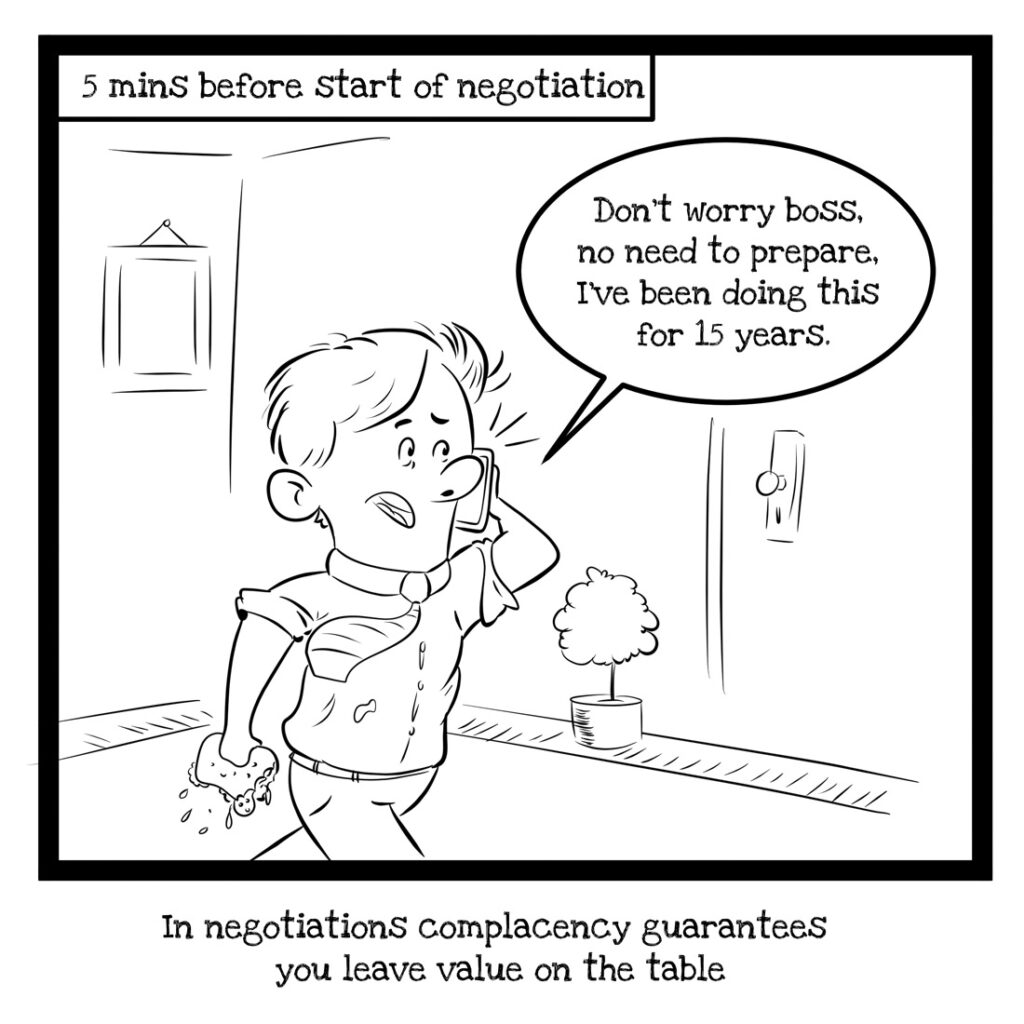
Negotiation complacency flourishes in environments where routine breeds false confidence. When tasks become overly familiar, organizations often develop an artificial sense of security, diminishing their drive for improvement. This stagnation typically stems from an overdependence on established processes, leadership inertia, and organizational cultures that resist innovation.
Without active intervention, complacency embeds itself deeply into operational frameworks, favoring predictable routines over dynamic approaches that foster creativity, calculated risk-taking, and adaptability. Let’s examine the three primary catalysts of negotiation complacency:
Past achievements can create a deceptive comfort zone. Negotiators often assume that previously successful strategies will yield similar results, failing to recognize how changing circumstances and objectives demand fresh approaches.
Historical outcomes frequently create perception barriers that limit possibilities. When negotiators allow past results to define future goals, they unconsciously cap their potential. Success parameters should align with current opportunities rather than historical benchmarks.
While reusing contract terms, pricing models, and negotiation tactics might seem efficient, this approach often yields diminishing returns. It creates predictable patterns that counterparties can anticipate and counter effectively. Our client engagements consistently reveal how behavioral patterns in negotiations tend to repeat—making innovation and adaptability crucial for success.
When complacency meets overconfidence, thorough preparation becomes the first casualty. Organizations systematically undervalue the critical nature of comprehensive preparation, often settling for surface-level information and untested assumptions rather than conducting rigorous research. In today’s dynamic business environment, each negotiation demands a fresh preparatory approach—treating every engagement as unique rather than recycling old frameworks.
A pervasive myth in business suggests that time equals expertise—particularly in negotiations. Many organizations assume that years spent in sales or procurement automatically translate into negotiation mastery. This fundamental misconception leads to a dangerous skills gap: companies neglect to invest in negotiation skill development, mistakenly viewing it as an innate talent rather than a cultivated competency. This oversight directly impacts profitability and competitive advantage.
The implications of negotiation complacency extend far beyond individual deals, creating ripple effects throughout an organization’s performance and culture. Here’s how complacency undermines business success:
Complacent negotiators operate within self-imposed constraints, rarely venturing beyond conventional solutions. This mindset transforms potentially collaborative negotiations into zero-sum transactions, where perceived power dynamics dominate outcomes. The combination of limited creative thinking and power bias—where negotiators overestimate their counterpart’s strength—consistently leads to suboptimal results.
When organizations deploy predictable, recycled strategies, they signal disengagement to their counterparts. This approach demonstrates a lack of investment in understanding current circumstances and evolving needs, gradually eroding trust and professional credibility. Strong business relationships require fresh thinking and genuine engagement with each interaction.
In today’s competitive landscape, complacent negotiators increasingly find themselves outmaneuvered by more sophisticated counterparts. Well-prepared, agile opponents recognize and exploit this complacency, often steering negotiations toward their preferred outcomes while maintaining control of the process.
The combination of unambitious targets and insufficient preparation creates a self-fulfilling prophecy of mediocrity. These agreements not only fall short of immediate potential but also fail to establish foundations for long-term value creation and sustainable partnerships.
Perhaps most significantly, negotiation complacency breeds organizational malaise. Team members who value growth and innovation become increasingly disengaged when constrained by rigid, outdated approaches. This disengagement creates a downward spiral: passive negotiation strategies lead to poor outcomes, further dampening team morale and effectiveness.
Transforming entrenched negotiation practices requires both awareness and action. The path forward begins with recognizing complacency’s presence and implementing systematic changes. Here’s your roadmap for excellence:
Strategic Value Continuous feedback serves as an early warning system, illuminating blind spots before they become systemic issues. This proactive approach prevents complacency from taking root in your negotiation practice.
Implementation Blueprint
Strategic Value Ambitious yet attainable goals serve as catalysts for innovation and excellence. When teams stretch beyond comfortable targets, they unlock new levels of performance and value creation.
Implementation Blueprint
Strategic Value Comprehensive preparation serves as the foundation for negotiation success, transforming potential risks into strategic advantages.
Implementation Blueprint
Strategic Value A collaborative mindset opens doors to innovative solutions and sustainable partnerships, creating value beyond traditional transactional approaches.
Implementation Blueprint
Strategic Value Negotiation excellence requires ongoing development and refinement. Regular skill enhancement ensures teams stay ahead of evolving business dynamics and emerging best practices.
Transform your negotiation capabilities through:
Remember: Negotiation excellence is a muscle that strengthens through deliberate, consistent exercise and expert guidance.
Strategic Value
Just as athletes monitor their equipment for wear, negotiators must vigilantly guard against performance degradation in dynamic business environments.
Implementation Blueprint
At Impact Negotiation Group, we envision negotiation excellence as more than individual achievement—it’s the cornerstone of organizational success. When organizations commit to uprooting complacency and embracing continuous improvement, they unlock unprecedented value creation opportunities.
Today’s negotiation landscape demands adaptability, innovation, and strategic thinking. Tomorrow’s leaders will be those who actively challenge the status quo and invest in developing world-class negotiation capabilities.
Is your organization ready to break free from negotiation complacency and achieve breakthrough results? Impact Negotiation Group offers comprehensive solutions tailored to your unique challenges and opportunities. Our proven methodologies have helped organizations across industries transform their negotiation outcomes.
Contact Impact Negotiation Group to begin your journey toward negotiation excellence. Together, we’ll build a foundation for sustainable success through:
The path to extraordinary negotiation outcomes starts with a single decision: the commitment to never settle for mediocrity. Let’s take that first step together.
Negotiation touches every part of our daily routines—whether you secure a better salary with your boss or haggle for a lower price at the market. It qualifies as an art, demanding a specific set of skills and strategies for success honed through negotiation training. Yet, some negotiators lean on tactics like good cop/bad cop, artificial deadlines, and even ethically questionable maneuvers to gain an edge. While these methods may work in a cutthroat zero-sum exchange, they risk igniting cycles of threats and demands that breed impasse and distrust.
This article dives into several common distributive negotiation tactics and explores the motives behind them. Let’s examine these techniques one by one.
The salami tactic slices a large demand into smaller, bite-sized pieces. Negotiators deploy this approach when the other side balks at big concessions but might nod at smaller ones. This method lets you chip away at your goal without triggering resistance. For instance, if you need to bring the price of a bed down from €850 to €700, asking for €700 outright might shut down the conversation. Instead, you might start by requesting a 10% discount. Next, propose a €40 rebate on a showroom model, and later, point out a minor flaw to secure an extra €25 off. Before long, these incremental concessions bring you to your €700 target.
In the good cop/bad cop routine, two negotiators adopt contrasting roles. One takes on a friendly, empathetic demeanor, while the other plays the aggressive, confrontational part. This setup nudges the other party toward trusting the friendlier figure, making them more willing to concede ground.
Cherry picking means selectively highlighting facts that bolster your case while setting aside details that might undermine it. This technique works because it makes your arguments appear stronger and encourages the other side to lower their resistance to your demands.
The limited authority tactic sees a negotiator claim they lack the power to make certain concessions—even when they do. This strategy buys time and invites further thought. However, overusing it can frustrate the other party, prompting them to insist on speaking directly with someone who holds real decision-making power.
With the nibble tactic, you insert a small, last-minute demand just as the deal nears closure. The goal here is to extract one final concession that might not have surfaced otherwise. Some even refer to it as the “one-last-thing” or “the Columbo” tactic. Reflect on who faces the real time crunch and whether you’re ready to add one more small request on the condition of securing another benefit.
Setting a firm deadline forces the opposing party into a sense of urgency, a dynamic also visible in extreme opening moves where timing shapes perceptions of power. This tactic pressures them to make concessions before time runs out, as a looming deadline creates a need for quick resolution. Ask yourself what unfolds if the deadline passes without reaching an agreement.
The walk away tactic signals that you’re prepared to leave the table if your terms aren’t met. This approach generates urgency and can compel the other side to reconsider their position. However, use this strategy with care, ensuring you always plan how to return to the negotiation if needed.
Negotiation remains a complex process, and distributive tactics represent just one piece of the puzzle. At their core, these strategies aim to tilt the outcome in your favor by shaping perceptions of power and pressure. To counteract them effectively, a negotiator must clearly define their own business drivers, set firm objectives, and know their alternatives (BATNA). Staying alert to the array of distributive methods and spotting them early often diffuses their impact.
Before you decide to deploy these tactics yourself, pause and ask: Are you facing a competitive, zero-sum showdown or a collaborative conversation? Finally, align your approach with internal stakeholders and weigh whether risking trust is a price worth paying for the potential gain.
Within the bustling corridors of business, many believe that one either possesses natural negotiating talent or falls short entirely. Such a binary view overlooks the transformative nature of negotiation—a skill anyone can sharpen through deliberate practice and tailored training.
Every workday brims with interactions that require negotiation, whether the conversation unfolds between colleagues or with external partners. These dialogues define our progress, steer deals, and shape lasting relationships.
The ability to negotiate effectively can dictate the pace at which agreements materialize, secure favorable terms, and build enduring rapport. Companies that empower their people with robust negotiation training witness not just improved outcomes, but a culture that thrives on clear communication and shared success.
Remarkably, numerous professionals engage in high-stake discussions—managing budgets, achieving sales targets, and overseeing substantial expenditures—without ever receiving formal guidance. This oversight not only jeopardizes potential deals but risks undermining the company’s future growth.
The following sections offer a comprehensive guide on negotiation training, addressing critical questions such as:
Each segment lays out practical insights and clear steps designed to close the gap in your team’s capabilities.
Investing in negotiation training delivers tangible benefits that ripple through every layer of an organization. Far more than a “nice-to-have,” negotiation expertise drives improved deal outcomes, reinforces relationships, and underpins a culture of effective conflict resolution.
Each of these elements contributes to a lasting improvement in commercial performance. When your team masters negotiation, they not only close deals more successfully—they build a foundation for future growth and competitive advantage.
Negotiation skills prove invaluable across a broad spectrum of roles. Although sales and procurement professionals often take center stage in negotiations, nearly every position within an organization benefits from refined negotiation abilities.
By prioritizing negotiation training for the roles that directly influence your company’s performance and tailoring programs to fit distinct needs, you create a workforce that negotiates with precision, confidence, and collaborative spirit.
The market offers a wide range of negotiation training providers, yet quality varies greatly. With no standard accreditation in place, you must evaluate your options carefully. Given the significant investment and the fact that negotiation training rarely happens every year, you need a partner who truly understands your organization’s unique challenges. Choose a provider that offers customized, practical training designed to deliver real results for your team.
By carefully evaluating these factors, you ensure that the negotiation training provider you choose not only meets your immediate needs but also lays the groundwork for sustainable, long-term success.
Timing plays a crucial role in the success of negotiation training. Two dimensions come into focus: the optimal point in one’s career and the best period during the business cycle.
The ideal training schedule balances career progression with the operational needs of the business, ensuring that every participant benefits fully from the experience.
Negotiation skills constitute a critical asset for every professional. Whether closing a high-stakes deal or resolving internal conflicts, effective negotiation drives better outcomes, solidifies relationships, and fuels business growth. Tailor your training investments to the roles that directly influence your financial performance, and extend development to supporting functions that bolster overall effectiveness.
Choose a negotiation training provider with proven expertise, interactive methodologies, and a commitment to customization. Assess their ability to deliver both theoretical insights and practical experience, and verify that they offer continued support beyond the training session. Factor in the cost versus the potential uplift in commercial results—a small improvement can have a significant impact on your bottom line.
Begin training early in your organization’s talent pool and commit to ongoing development. Schedule sessions in line with your business cycles to maximize engagement and learning outcomes. With a well-structured, continuous training program, you build a workforce that negotiates with precision, confidence, and creativity.
At Impact Negotiation Group, we work passionately to reshape how negotiations unfold. Our hands-on programs deliver clear, measurable results for businesses—from major Fortune 500 companies to nimble SMEs. We take pride in generating strong returns and arming professionals with the negotiation skills they need to excel in fiercely competitive markets.
Choose negotiation training as a cornerstone of your professional growth rather than an optional extra. Build a workplace where clear communication, genuine respect, and creative problem-solving thrive. When you do so, you not only secure better deals—you lay the foundation for enduring partnerships that propel your organization forward.
Reach out to us today and discover how our tailored negotiation training can empower your team, sharpen your competitive edge, and drive sustainable success across your business landscape.
Understanding key negotiation terms is essential for anyone looking to navigate complex discussions and secure favorable outcomes. Whether you’re managing high-stakes business deals or smaller transactional negotiations, knowing the lingo helps you strategize effectively and dovetails with comprehensive negotiation training that turns theory into habit. Below is a comprehensive glossary that defines common negotiation terms and concepts used in business, communication, and legal contexts.
When you negotiate for yourself rather than for someone else, you act as a principal. You make decisions based on your own interests and steer the conversation with your judgment. This role demands full ownership of the choices and their outcomes.
A bold opening offer sets an anchor that guides the entire negotiation. Your initial number becomes the benchmark, and every subsequent offer or counteroffer is measured against it. This technique helps shape the final outcome in your favor.
When discussions reach an impasse, a neutral third party steps in as an arbitrator. They listen to both sides and then make a decision that all parties agree to follow. This approach breaks deadlocks and gets negotiations moving again.
Your aspiration point is the ideal outcome you target during negotiations. It represents the best-case scenario you strive for and guides your strategy. Keeping your aspiration point clear ensures that you remain focused on achieving top results.
A strong BATNA gives you the confidence to walk away if the deal doesn’t meet your minimum needs. Knowing your backup plan protects you from accepting unfavorable terms and strengthens your overall bargaining position.
In the Good Cop/Bad Cop routine, the “bad cop” adopts a tough stance to pressure the other side into concessions. This role contrasts with the “good cop,” who later shows a friendlier approach, making the other party more inclined to yield.
A blind spot is a detail or opportunity you miss because your view remains too narrow. Recognizing these gaps encourages you to broaden your perspective and uncover solutions that benefit both sides.
Bluffing involves overstating your position or pretending you’re ready to walk away to force concessions. Executed well, this tactic pressures the other side to move, though it requires precise timing to avoid backfiring.
Your BPA is the best deal that meets the core interests of everyone involved. It represents the ideal outcome where both parties capture maximum value and feel they’ve achieved something significant.
Brain storming gathers a flood of ideas without judgment. This creative process can spark fresh solutions and innovative approaches that break through negotiation deadlocks, helping both sides discover new opportunities.
Brinkmanship pushes negotiations close to collapse, testing the other side’s limits. This high-risk tactic forces concessions but demands a steady hand to avoid a total breakdown of discussions.
Securing buy-in means winning the other side’s genuine support for your proposal. When both parties feel committed to the outcome, the conversation flows more smoothly and paves the way for lasting agreements.
To capitulate means to finally yield after holding out for too long. Surrendering too soon can signal weakness, so it’s vital to hold firm until you can secure the best possible terms.
Cherry picking occurs when one side takes only the most attractive parts of an offer while dismissing the rest. To counter this, present your terms as a complete package so that every condition is evaluated together.
Compromise requires both sides to give a little in order to meet in the middle. Although neither party may achieve all their initial goals, a fair compromise creates an outcome that everyone can accept and build upon.
A concession is a calculated offer made to move the negotiation forward. When you offer a concession, you trade something of lesser value for a gain that is more important to your overall objectives.
Consensus emerges when all parties agree on a particular point. Achieving consensus indicates that everyone shares the same view, which makes it easier to implement the final agreement.
A counteroffer responds to an initial proposal with modified terms. It signals that you are not ready to accept the first offer while showing that you remain open to finding common ground.
A creative concession provides the other side with high value at little cost to you. This gesture builds trust and moves the discussion toward a mutually beneficial outcome without compromising your key interests.
Crunch is a tactic that pressures the other side to reconsider their position without offering an immediate new number. This move forces a quick reassessment and can lead to a breakthrough in the negotiation.
Deadlock occurs when both sides refuse to budge, halting the conversation. When you encounter a deadlock, fresh ideas or additional data are needed to restart the discussion and move toward a resolution.
Defensive deception uses misleading information to level the playing field when you suspect the other side hides its true position. This tactic can neutralize their advantage, though it risks backfiring if uncovered.
A direct communication style means stating your points clearly and openly. Speaking plainly helps prevent misunderstandings and builds trust, ensuring that everyone is on the same page during the negotiation.
Distributive negotiation is about claiming the maximum share of a fixed resource. In these competitive scenarios, each side battles to secure the best possible deal, often focusing primarily on price or similar metrics.
Escalation raises the stakes by adding new demands or intensifying pressure. This tactic shifts the dynamics quickly, forcing the other side to adjust their strategy under increased tension.
An end-run bypasses your immediate contact to seek approval from a higher authority. This maneuver disrupts the usual process and forces decision-makers to reconsider the terms on your side.
An expressive communication style involves showing your emotions openly during negotiations. When used appropriately, genuine expressions can build rapport and signal sincerity, though too much emotion may distract from the facts.
Presenting a fait accompli means declaring a decision as already final. This bold tactic pressures the other side to accept the outcome quickly, limiting further discussion.
The Good Cop/Bad Cop strategy splits your negotiating team into two distinct roles. One member takes a tough, unyielding stance while the other shows understanding and flexibility, pushing the other side to concede through contrast.
Haggling is the back-and-forth over details, usually focused on price. This iterative exchange continues until both parties agree on a number that feels acceptable.
A hidden agenda involves keeping certain goals secret to gain a tactical edge. Concealing your true interests can sometimes provide leverage, though it may harm trust if discovered.
Hot buttons refer to topics that trigger strong emotional reactions. Recognizing these allows you to steer clear of unnecessary conflict or use them tactfully to guide the conversation in your favor.
A hypothetical question poses an “if” scenario to explore possibilities without committing to a fixed position. This technique opens up new ideas and reveals the other side’s underlying interests without pressure.
An indirect communication style conveys disagreements or criticisms through subtle hints rather than blunt statements. This approach suits cultures that prize courtesy and helps avoid direct confrontation.
Integrative negotiation seeks a win–win outcome by addressing shared interests. Rather than dividing a fixed resource, both sides work together to expand the value available to everyone.
Interests are the true drivers behind each position—your underlying needs and desires. Revealing these can unlock opportunities for creative solutions that benefit all parties, instead of merely trading offers.
Your LAA sets the minimum terms you will accept for a deal. This boundary ensures you never settle for less than what meets your critical requirements, guiding you when it’s time to walk away.
Legitimacy builds your position on objective standards or external benchmarks. When your terms appear fair and well-supported, they become harder to dispute and more likely to gain acceptance.
Logrolling means exchanging concessions on issues of different importance. Each side trades something of lesser value for something more significant, helping both reach a better overall deal.
A lose–lose outcome happens when both sides hold too rigidly to their positions and miss out on mutual gains. This situation leaves everyone with less than they could have achieved through flexible collaboration.
In a lose–win scenario, one side concedes more than is fair while the other reaps most of the benefits. This imbalance often occurs when one party underestimates their value or overplays their hand.
Magical Math uses overly complex or deceptive calculations to justify an offer. This tactic creates an illusion of precision, distracting from the core issues, even though the numbers don’t fully add up.
In group negotiations, majority rule means the final decision reflects the preference of most members. Even if some disagree, the outcome follows the collective choice, guiding the agreement.
Mediation brings in a neutral third party to help resolve conflicts. The mediator facilitates a dialogue that helps both sides find common ground, steering the discussion toward a mutually acceptable solution without imposing a decision.
Your MDO is the best-case scenario you aim to secure. This ideal outcome serves as a beacon, guiding your strategy and helping you stay focused on what you truly want from the negotiation
Using the mirror technique, you repeat key phrases from your counterpart to build rapport and encourage them to clarify their thoughts. This simple strategy fosters a deeper connection and opens up the conversation.
Presenting multiple offers gives your counterpart several options instead of locking them into a single number. This variety sparks broader discussion and helps both sides explore creative solutions.
A negotiation coalition forms when two or more parties team up to strengthen their bargaining position. These temporary alliances allow groups to pool their resources and negotiate from a place of greater power.
Nibbling means asking for small extras after the main deal is nearly finalized. This final tactic extracts additional value without risking the overall agreement, relying on careful timing and subtle persuasion.
No-oriented questions prompt the other side to say “no” in a way that reveals their true boundaries. This counterintuitive approach gently probes their limits without forcing a premature “yes.”
Non-verbal cues—like gestures, facial expressions, and posture—often reveal more than words. Observing these signals gives you insight into your counterpart’s true feelings, allowing you to adjust your strategy in real time.
When you present a package, you bundle all terms together instead of offering them one at a time. This forces your counterpart to consider the full deal as a single entity rather than picking and choosing favorable points.
Paralanguage covers the nuances of how you speak—tone, pitch, and pace—that add meaning beyond your words. These subtle signals help convey emotion and intent, influencing how your message is received.
Principled negotiation focuses on addressing the core interests of both sides rather than fighting over fixed positions. This method emphasizes fairness, creative problem-solving, and objective criteria, building long-term trust and win–win solutions.
The puppy dog tactic lets a buyer try out a product or service before making a full commitment. This trial period builds an emotional connection and often tips the scales in favor of closing the deal once the benefits are experienced firsthand.
Purchase order financing provides funds by assigning purchase orders to a third party. That party collects payments and advances money to keep your operations running smoothly, ensuring consistent cash flow during critical negotiations.
The reciprocation principle rests on the idea that when you offer something—a concession, a favor—the other side feels compelled to return it. This mutual exchange builds a cooperative spirit that can drive the negotiation toward a balanced outcome.
A red herring is a distraction introduced to steer the other side away from the main issue. This tactic can misdirect focus, giving you an opportunity to emphasize what truly matters.
In a relationship-oriented culture, personal bonds and group harmony hold significant weight. Negotiations in these environments focus on trust and long-term connections, with decisions influenced by loyalty and mutual respect.
Your reservation price sets the limit for what you will accept, whether as a seller or a buyer. Knowing this threshold helps you avoid agreeing to a deal that doesn’t meet your minimum requirements, keeping you in control of the negotiation.
A reserved communication style means keeping your emotions and strong opinions in check to maintain professionalism. This calm and measured approach ensures that the focus remains on the facts and the issues at hand.
A risk-averse negotiator favors certainty over the possibility of a higher, but less guaranteed, reward. This approach leans toward secure, predictable gains, ensuring that every agreement meets a minimum standard of safety.
A risk-seeking negotiator welcomes uncertainty if it offers the potential for larger rewards. This bold approach involves taking calculated chances, even when the outcome remains unpredictable.
Splitting the difference means both sides agree to meet halfway between their positions. While this tactic can quickly break a deadlock, it sometimes leads to less-than-optimal outcomes if both parties settle too easily.
SWOT stands for Strengths, Weaknesses, Opportunities, and Threats. This framework lets you assess your position alongside that of your counterpart, providing a solid basis for a strategic, well-informed discussion.
A stakeholder is anyone with a vested interest in the outcome of a negotiation. Their influence, though sometimes indirect, can shape decisions and steer the overall direction of the discussion.
Stonewalling happens when one side refuses to budge or consider new ideas. This tactic stalls progress and forces the other side to seek creative ways to break through the impasse.
In a task-oriented culture, the focus remains on achieving clear results and meeting deadlines. Negotiators from such environments concentrate on practical outcomes, emphasizing efficiency and measurable goals over personal rapport.
Tactics are the specific moves you use to gain an edge in a negotiation. They can range from strategic pauses and silent moments to setting firm deadlines. Each tactic plays a key role in building your overall approach.
The unanimity rule requires that every member of a group agree on a decision before it stands. Even if a few disagree, the final outcome reflects the majority’s view, ensuring that the agreement has broad support.
A walk-out is a dramatic move where you leave the table to signal that the current terms are unacceptable. This bold step forces your counterpart to rethink their position, though it risks ending the conversation if overused.
Your walk-away point defines the worst terms you’re willing to accept. Knowing this boundary ensures that you never agree to a deal below your essential requirements, keeping you in control throughout the negotiation.
The winner’s curse occurs when you settle too quickly or set your goals too low, later realizing that you could have negotiated a better deal. It serves as a reminder to push for maximum value and never settle for less than you deserve.
In a win-lose negotiation, one side gains at the expense of the other. This zero-sum approach often leaves the losing side feeling shortchanged, as every benefit for one party directly harms the other.
A win-win negotiation produces an outcome where both sides feel they have achieved something positive. In these discussions, each party works together to address key interests, creating a deal that benefits everyone involved.
The ZOPA represents the overlap between your acceptable terms and those of your counterpart. This zone is where a mutually beneficial deal becomes possible, serving as the target for your negotiation efforts.